Unravelling the Kashmir Knot by Hingorani Aman M
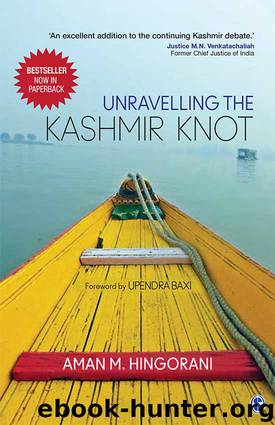
Author:Hingorani, Aman M.
Language: eng
Format: epub
ISBN: isbn:9789351509707
Publisher: Sage Publications India Pvt, Ltd -- eBooks
Competence of the PIS of J&K to Cede Territory of the State
If the Indian Parliament cannot cede territory of any of its constituent states, can a constituent state cede part of its territory? This issue may be examined in light of the broader proposition, namely, whether a constituent state can secede from the Union of India? After all, if the constituent state lacks the power to secede from the Union of India, it lacks the power to cede part of its own territory.
Reference in this regard may be made to the view of the US Supreme Court. In George W. White,28 the US Supreme Court considered the question of whether the State of Texas could, by the Ordinance of Secession, ratified by a majority of its citizens and given effect to by Acts of its legislature, secede from the US. Salmon P. Chase, the then US Chief Justice, held that it could not as the Constitution ‘looks to an indestructible Union, composed of indestructible States’ and that when ‘Texas became one of the United States, she entered into an indissoluble relation’.29
Another case in point is that of the Commonwealth of Australia. The Commonwealth Constitution of Australia derives its legal authority from an Act of the Imperial (British) Parliament, 63 and 64 Vic. c. 12, and is the outcome of an agreement between the States named in the Preamble—New South Wales, Victoria, South Australia, Queensland and Tasmania—together with Western Australia. Section 3 of the Act provides that the states ‘shall be united in a Federal Commonwealth under the name of the Commonwealth of Australia’. Nicholas notes that in 1935, the petition from the State of Western Australia to secede from the Commonwealth came before a Joint Committee of the House of Commons and the House of Lords, which was, however, unable to hold that the State had a right to secede and recommended that the petition not be allowed.30
As far as India is concerned, Article 1 of the Constitution of India looks to an indestructible ‘Union of States’. The Indian Supreme Court, in its 9-judge decision in S.R. Bommai, took the view that a constituent state, ‘being the creature of the Constitution … has no right to secede or claim sovereignty’.31
The Constituent Assembly Debates also confirm the intention of the Constitution-makers that a constituent state, having acceded to the Union of States, had no right to secede from the Union.32 The sovereign ruler of the PIS of J&K did accede to the dominion of India. Moreover, as already discussed, the people of a portion of India, whether it be in the territory of the PIS of J&K or any other state, did not have a right to self-determination.
Even otherwise, the Constitution of Jammu and Kashmir of 1957, framed by the Constituent Assembly of the PIS of J&K pursuant to the proclamation of the sovereign ruler of the said state, Yuvraj Karan Singh, rules out the secession of the PIS of J&K from the Union of India. The ‘territory of State’ is
Download
This site does not store any files on its server. We only index and link to content provided by other sites. Please contact the content providers to delete copyright contents if any and email us, we'll remove relevant links or contents immediately.
| Africa | Americas |
| Arctic & Antarctica | Asia |
| Australia & Oceania | Europe |
| Middle East | Russia |
| United States | World |
| Ancient Civilizations | Military |
| Historical Study & Educational Resources |
The Sympathizer by Viet Thanh Nguyen(4447)
The Rape of Nanking by Iris Chang(4266)
World without end by Ken Follett(3512)
Ants Among Elephants by Sujatha Gidla(3495)
Blood and Sand by Alex Von Tunzelmann(3243)
Japanese Design by Patricia J. Graham(3220)
The Queen of Nothing by Holly Black(2660)
City of Djinns: a year in Delhi by William Dalrymple(2582)
India's Ancient Past by R.S. Sharma(2493)
Foreign Devils on the Silk Road: The Search for the Lost Treasures of Central Asia by Peter Hopkirk(2482)
Tokyo by Rob Goss(2469)
Inglorious Empire by Shashi Tharoor(2463)
In Order to Live: A North Korean Girl's Journey to Freedom by Yeonmi Park(2411)
Tokyo Geek's Guide: Manga, Anime, Gaming, Cosplay, Toys, Idols & More - The Ultimate Guide to Japan's Otaku Culture by Simone Gianni(2400)
India's biggest cover-up by Dhar Anuj(2381)
The Great Game: On Secret Service in High Asia by Peter Hopkirk(2375)
Goodbye Madame Butterfly(2289)
Batik by Rudolf Smend(2213)
Living Silence in Burma by Christina Fink(2093)
